Content Creation
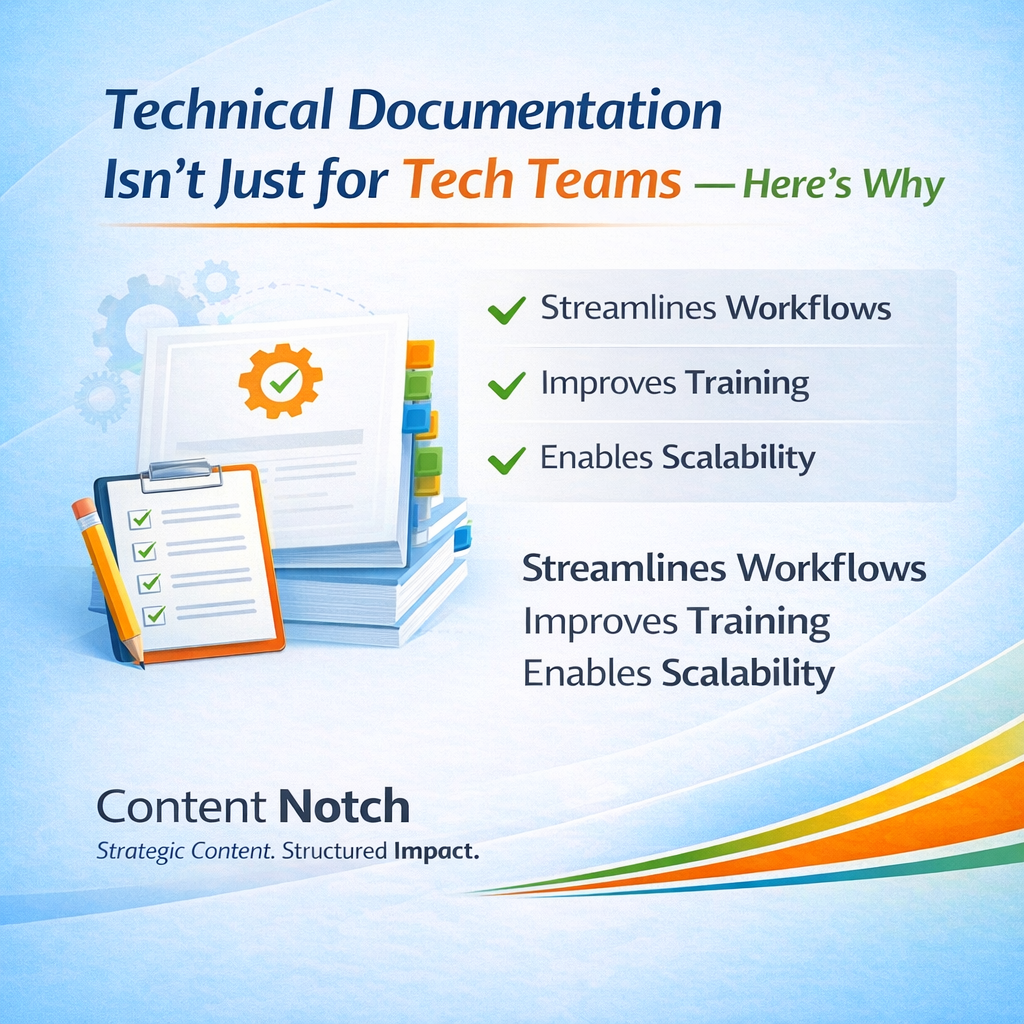
Technical Documentation Isn’t Just for Tech Teams — Here’s Why
When people hear the term technical documentation, they often associate it with developers, IT teams, or complex systems.
But in reality, technical documentation goes far beyond technology.
At its core, it is simply structured information that helps people understand, follow, and execute processes clearly.
And that makes it relevant to every function within a business.
The Misconception Around Technical Documentation
Most businesses assume documentation is only needed for:
• software systems
• technical manuals
• product instructions
Because of this, non-technical teams often operate without structured documentation.
Instead, they rely on:
• verbal instructions
• scattered notes
• email threads
• individual knowledge
While this may work initially, it creates challenges as the business grows.
What Happens Without Structured Documentation
When documentation is not properly structured, businesses often face:
1. Inconsistent Processes
Different team members handle the same task in different ways, leading to variability in outcomes.
2. Dependency on Individuals
Critical knowledge remains with specific employees instead of being accessible to the team.
3. Communication Gaps
Instructions are misunderstood, missed, or interpreted differently.
4. Time Loss
Teams spend more time asking questions than executing tasks.
5. Scalability Issues
New hires struggle to adapt quickly due to lack of clear guidance.
Where Technical Documentation Actually Applies
Technical documentation is not about “technical language.”
It is about structured clarity.
It can be applied across:
• HR processes (onboarding, policies)
• Sales workflows (lead handling, follow-ups)
• Marketing activities (campaign execution, content flow)
• Operations (task workflows, SOPs)
• Customer support (response frameworks, escalation processes)
In all these areas, documentation ensures that work is repeatable, understandable, and scalable.
What Good Documentation Looks Like
Effective documentation is not lengthy — it is structured and purposeful.
It typically includes:
• clear step-by-step processes
• defined responsibilities
• expected outcomes
• supporting examples or templates
• logical flow of information
When structured properly, documentation becomes a reference system, not just a file.
How Structured Documentation Supports Business Growth
As businesses grow, complexity increases.
Structured documentation helps by:
Improving Efficiency
Teams spend less time clarifying and more time executing.
Enabling Consistency
Processes are followed uniformly across the organization.
Supporting Training
New team members can onboard faster with clear guidance.
Reducing Errors
Clear instructions minimize miscommunication and rework.
Enabling Scalability
Processes can be replicated without dependency on individuals.
The Role of Structure in Documentation
Documentation is not just about writing things down.
It is about how information is organized and presented.
Even well-written content can fail if it lacks:
• logical flow
• clarity of steps
• clear outcomes
This is where structured content plays a critical role.
Final Thought
Technical documentation is not limited to tech teams.
It is a business necessity.
Any organization that wants to grow sustainably needs structured documentation across functions.
Because when information is structured clearly:
• teams perform better
• processes become efficient
• and businesses scale with confidence